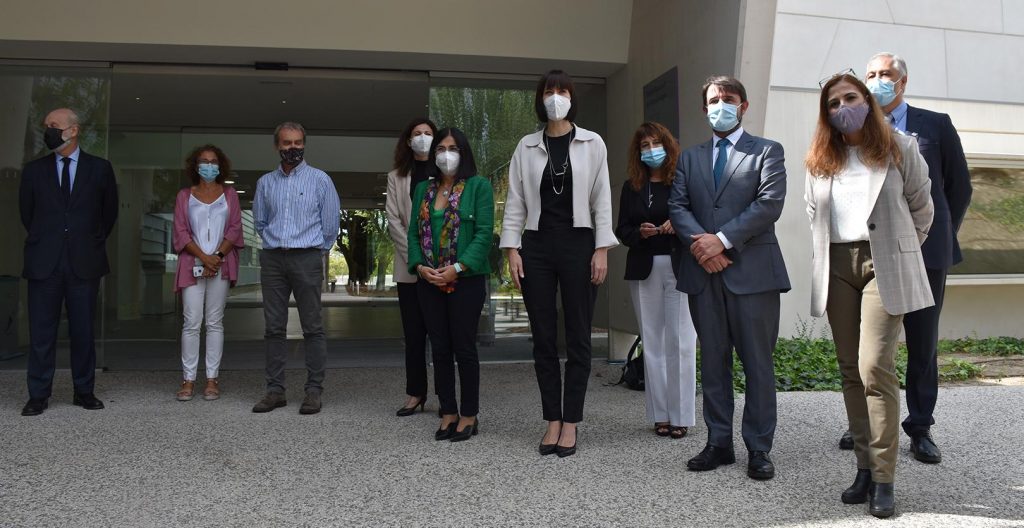
The Ministers of Health, Carolina Darias, and of Science and Innovation, Diana Morant, visited the National Microbiology Centre (CNM) of the Carlos III Health Institute (ISCIII). They were accompanied by ISCIII and CNM (ISCIII) leadership, including Cristóbal Belda (Director of ISCIII), Manuel Cuenca (Secretary General of ISCIII), Miguel Calero (Deputy Director General of Applied Services, Training and Research of ISCIII), Isabel Jado (Director of CNM, ISCIII) and Heads of key Units: Inmaculada Casas (Respiratory Viruses and Influenza Unit, CNM, ISCIII; and coordinator of the European project), Ángel Zaballos (Genomics Unit, CNM, ISCIII) and Isabel Cuesta (Bioinformatics Unit, CNM, ISCIII).
The Ministers visited the CNM (ISCIII) to learn about the research and national coordination work in genomic sequencing of SARS-CoV-2. The visit coincided with the awarding of the European project “Improvement of Sequencing Infrastructures and Capacities to Respond to the COVID-19 Pandemic’, to the CNM (ISCIII), involving an investment of over €5 million”. This project will enhance national capacities for sequencing and variant analysis, facilitating the transition from traditional microbiological surveillance to molecular methods. It builds on the national laboratory network established through the Ministry of Health’s Centre for the Coordination of Health Alerts and Emergencies (CCAES) protocol.
Genomic sequencing integration protocol
Earlier this year, Spain reinforced its sequencing capabilities by approving the ‘Protocol for the Integration of Genomic Sequencing in the Surveillance of SARS-CoV-2’, which was launched by Ministry of Health’s CCAES. This resulted in the establishment of the RELECOV network, which is coordinated by the CNM (ISCIII) and comprises laboratories from all Autonomous Communities and Cities. This national initiative increased sequencing capacity, brought Spain into line with European standardsand enabled it to secure the current European project.
The pandemic has highlighted the need to strengthen surveillance systems and expand genomic sequencing at the national level, in which CNM (ISCIII) and the RELECOV network have played a pivotal role. Increasing sequencing capacity allows for better tracking of variant spread and the early detection of new strains. RELECOV operates through regional regional Public Health authorities, who enter data into the SiViEs system, managed by the National Epidemiology Centre (CNE) of ISCIII and the Ministry of Health, ensuring comprehensive national epidemiological data.
To further enhance genomic surveillance, the new Infectious Diseases area within the Biomedical Research Network Centre (CIBER) will bring research groups focused on transitioning from conventional microbiology to a genomic, molecular-based approach.
Source: Government of Spain, Ministry of Science and Innovation, News, September 16, 2021.


Co-funded by the European Union. Views and opinions expressed are however those of the author(s) only and do not necessarily reflect those of the European Union or the European Health and Digital Executive Agency. Neither the European Union nor the granting authority can be held responsible for them.
 English (UK)
  Español